Translate

Wednesday, September 5, 2012

Spring Has Sprung

Spring arrived early this year. 


These photos were taken August 24th. The plum blossoms usually signal the beginning of spring which arrived about a week earlier than normal. It was especially heartening to see the plum tree blossoms being visited by all sorts of insects including bees, bumblebees and butterflies. 

Last year most of the blossoms got turned to mush when a heavy downpour of rain came before they’d been pollenated, which resulted in a very small crop. This year I reckon every single flower got pollenated as the weather and insect visitation was almost perfect for an entire week.

I was so delighted at this first sign of spring I felt a video would be the best way to capture it, as the still photos just didn’t do it justice. They couldn’t possibly capture the sound of bees buzzing or the birds chirping in the surrounding trees. 

I found this video is best enjoyed at night with the volume turned up.

Enjoy...


Monday, August 20, 2012

Pergola Doubles as Winter Greenhouse

When I first built the pergola I intentionally chose the sunniest spot in the garden, so it would be a nice place to sit over the summer, in the shade of the grape vine. However the paved area never gets used for outdoor living over the cooler months and it seemed a pity to let all that sunshine go to waste. So one thing I decided to try this year was to turn the pergola into a makeshift greenhouse. I didn’t want to spend too much money and I wanted to keep it as simple as possible as it would only be temporary until the grapes come on again later in the spring.


So using a couple of garden boxes I knocked together a couple of years ago, I got them all planted out with garden mix and seedlings. Then I got a 10 metre roll of clear polythene and a few lengths of timber to make up the greenhouse.


Using the timber in pairs I sandwiched the polythene in between and nailed the pair of them together whilst laid out on the ground. This would serve as a weight and a means of attaching it to something solid. I did this on one end first then draped the polythene over top of the pergola.


Then pulling it tight I was able to establish the correct length and then attached a couple more bits of timber with the polythene sandwiched between them and nailed together. Then using the same method I covered up the southern end (that’s the cold end for us here in NZ) as shown below.


I decided to grow Pak choy and Brocolli. Pak Choy are frost tender. Brocolli is a bit more hardy but it would be an interesting experiment to see the difference between these and some that I just planted in the ground as normal.
A few weeks later and the Pak Choy were all finished and the brocolli were coming on beautifully with little flower heads beginning to form. The brocolli inside the greenhouse were about 3 times the size of the ones growing in the garden. So you can imagine my distress when my wife reported that something disastrous had happened in the garden...


We suddenly had some gale force winds which whipped through the garden and half of the brocollis got completely snapped off in the wind.

I hate it when that happens!

It seems this part of the garden is more exposed to the wind than where I would normally grow Brocollis and other winter vegetables.

Anyway, I haven't given up on the idea completely. What this initial test proved was just how much better things can grow in a greenhouse environment and in a spot where there's more sun. I just need to commit to spending a bit more time and money using more robust materials and construction methods. You can be sure I'll do a post about it when that happens.

Wednesday, July 4, 2012

Autumn colours

There’s not that much about winter that I look forward to each year. But every new season does have something to offer in the way of colours and other little surprises that pop up in the garden.

Even simple things like how the light dances on the leaves of the trees and creates a whole different ambience is something you learn to appreciate.


Even after the trees have shed all their leaves there’s still some beauty to found...


...sometimes in the most surprising of places.

*****

A couple of years ago a friend of mine was clearing a corner of his garden and he asked me if I wanted some of the Taro plants he’d dug up. I thought they’d do OK under the bridge by the sleepout where there’s a little stream. I just like them as foliage looking down on them as you walk over the bridge. 

This year, to my surprise one of them actually flowered. That was a bonus I wasn’t counting on. There aren’t many plants that flower in the dark wet environment that winter brings in that part of the garden. 


It made my day when I saw that.

Monday, April 30, 2012

The Bougainvillea

I’m satisfied with the various areas I’ve created for growing vegetables and they seem to be producing reasonably well, so this year I’ve been thinking about different ways to beautify my garden.

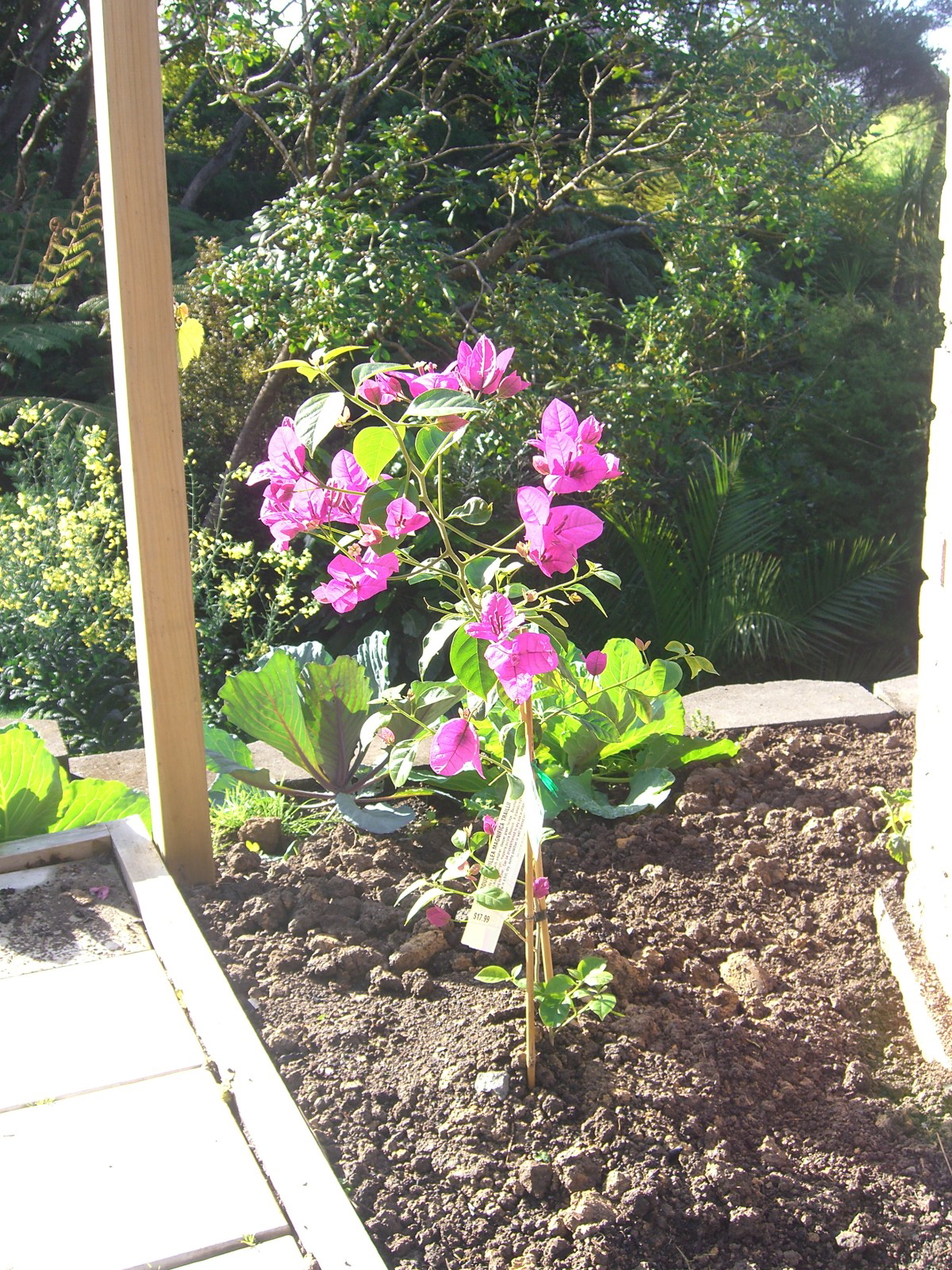
One feature in the garden that lends itself well to being beautified is the pergola. So I decided to grow a bougainvillea vine over one half of it.
The plant I chose was a bright magenta variety that’s pretty common in NZ. I've seen these growing in various places in both public and private gardens and they’re great for adding a stunning display of colour in the summer. But they look their best when grown over some kind of structure like a fence, trellis or pergola.
As usual I like to show a BEFORE shot:


I planted the vine in a small triangle space between the pergola and the BBQ (October 2010). Then as it grew I started training it toward the back right post cutting off any lateral shoots to encourage a single stem to grow in that direction.


As it grew nearer to the post I allowed one of the laterals to grow so that it forked off in two directions. Then I just started winding it around the post in two different directions to try and create a plaited effect.


I’m reasonably happy with how it’s grown so far over it’s first full season. It’s reached the top and started flowering. I’ve discovered how easy they are to grow. In fact if you weren’t paying attention they'd quickly get out of control and grow every which way, so they need to be pruned regularly especially when training them to grow a certain way.


I have made a point of not winding the stems too tightly around the post as these will gradually thicken and therefore tighten as the plant matures. I'm pleased with the plaited effect so far but I’ve had to keep trimming any lateral shoots to maintain the effect, (it’s also a good idea for safety reasons as the Bougainvillea produces hundreds of sharp barbs – pretty lethal if you stand too close or brush up against it). I'll probably let the laterals go wild on the top of the pergola next season which I’m hoping will create a nice display of colour.


One thing I’ve learned about the Bougainvillea is that the bright magenta part of the plant is not actually the petal of the flower. The petals are white as can be seen in the above photo.

I'll be sure to add a few pics later to show the final effect.

--------------------------------------------------------------------------------------

Update: photos taken 28 December 2012


It makes a nice place to sit in the summer...


------------------------------------------------------------------------------------------------------

Update: photos taken 12-14 Dec 2013


--------------------------------------------------------------------------------------------------------------------photo taken Jan 2018
I love the dramatic splash of Magenta on the approach to the garden now that the Bougainvillea is properly established. It seems to thrive best in hot, dry conditions. It’s become a real focal point of the garden.

-----------------------------------------------------------------------------------------------------------

25th Dec 2018:

The bougainvillea is such a beautiful feature in the garden it's become the ideal spot for taking family photos.


-----------------------------------------------------------------------------------------------------------

Photo taken 4th April 2019:


The vine is now about 7 years old and the trunk has really thickened up nicely giving it the kind of character I was hoping for. One thing I underestimated however was how much pressure it would put on the pergola itself. Even though I tried to allow for the thickening trunk, it's now got quite a strangle-hold on the whole structure which is no longer standing square. My guess is that one day it will completely wreck the pergola. 

If that happens I may be able to remove the pergola from its grasp, leaving the Bouganvillea standing on it's own. By then it may not need the support the pergola initially provided.


Monday, March 26, 2012

Palms in the Garden

Palms are great for creating a tropical atmosphere in the garden.  I’ve purchased and acquired several palms over the years, half of which I've kept in pots. There are so many different kinds so I’ve been trying to learn how to identify the difference between them. The learning curve involves understanding how they grow including knowing how big they get and hence where to plant them.

One palm I bought about 6 years ago and planted on the edge of the bush was a Bangalow palm. I bought it when it was small but it was starting to get quite big for the place where I put it so I realized I needed to move it. However, transplanting it was not going to be easy.

It was in a very awkward spot and the root ball was so big it was going to be too heavy to lift. As usual rather than asking anyone to help me, I figured out how to do it on my own using the McGyver approach. After digging around the root ball, I was able to slip an old shovel blade under it, then I used a couple of ratchet ties strapped around it to lift it out of the hole. Then I wrestled it into the wheelbarrow ready to move. 

What I love about mature Bangalows is their lovely smooth bright green trunk. I knew just the place for it on the approach to the sleep out. 
The bangalow will grow a lot bigger than this yet. I wouldn't want to transplant one that's any bigger than this. I love the way it catches and filters the afternoon sun in its new location. 

My next task is to move a nikau palm which I now realize is also in the wrong place (pictured next to the Bangalow in the picture at the top). I also have a Phoenix palm which I've decided to remove altogether as these grow to a massive size, far too big for my garden.

************************************

Update (19th Sept 2018)
This Bangalow palm loves it's new location and has grown to almost 3 times the height it was in the 6 and a half years or so since it was transplanted. The terracotta pot in the foreground is also a bangalow palm, which is how the big one started out.
These things grow surprisingly fast once they're planted in the ground. Keeping them in pots restricts their growth.


---------------------------------------------------------------------

Update April 2019
One palm I'm particularly pleased with is the one in pic below just in front of the handrail on the steps. It's a lower growing variety which I believe is known as a Majestic palm. I had this for many years in a pot and it was always quite small. When I finally put it in the ground it exploded into life and soon outgrew the space where I put it. 

So I moved it again to it's current position where it has continued to grow to a surprisingly large size compared to its compact size in a pot all those years. Thankfully, palms seem to be reasonably tolerant about being moved.


---------------------------------------------------------------------

Update Oct 2019
Palms create a lovely tropical ambience in the garden. One thing I've noticed is that if you plant into a big hole with lovely loose soil the palm tree can grow a lot bigger than if the soil is heavy or if there's insufficient space for the roots to grow.


Thursday, March 1, 2012

The Sleepout #7: Getting it finished

I’ve been terribly distracted over the last few months with some difficult personal issues that have taken my attention away from the garden (or at least keeping my blog up to date). Anyway, I was determined to finish off what I started last summer when I built the sleepout. It has been in a semi-finished state for months while I waited for the summer to roll around again.
One of the more pressing jobs I had planned this summer was to finish off the deck as it’s been a bit of a safety hazard.


I’m pleased to have finally got it finished, but it’s a shame it took so long because as you can see, the part I did first (last summer) has already discoloured compared to the bit I just finished. This is also one of the drawbacks of being surrounded by trees.

Another important job that needed doing was to brace all the sub-floor foundation posts...


The fact that it wasn’t braced properly was bugging me all winter especially when I was lying in bed and my wife got up and was walking around on the deck or inside the sleepout. It's really amazing what a difference the bracing makes. Now when she walks around, I’m barely aware of it.

Next, I need to get some underfloor insulation organised before winter. It gets pretty cold in the sleepout at night from June-Sept even though it’s well insulated in the walls and ceiling.

Read part 8 in this series here.


Tuesday, December 20, 2011

Oscar — The Dog-Cat!

Meet Oscar. He's a cat who thinks he's a dog!


I'm hardly ever alone in the garden as Oscar always follows me into the garden. He loves it when any of us humans go up there. He loves rolling around in the dirt, on the grass and waving his tail around my legs and chasing skinks. Unfortunately he's not been doing a very good job of keeping the birds out of the plum tree. The fruit is ripening on the tree and the birds are making a mess of it, pecking holes in all the fruit. I might have to dock his pay.

To tell the truth I think he's actually scared of going up there by himself as there are a few stray cats in the surrounding bush. He also takes the opportunity when we go up there to mark his territory, to let them know that this is HIS place and that they should stay away.

When he's in the house at night and he hears a strange noise outside, he growls like a dog. He scratches on the door to go in and out, just like a dog.

But I must admit, he climbs trees better than any dog I know.