Translate

Showing posts with label Birds in the Garden. Show all posts

Thursday, June 13, 2019

Expanding the Chook Pen

When we first got our chooks, one of Marie's male colleagues became inspired to do the same. It gave his kids an interest outside the house and they enjoyed getting the fresh eggs. However, the interest soon waned when they discovered how smelly they can be on a small city property when they're too close to the house and they decided they didn't want them any longer.

So suddenly, with only about 24 hours notice, we were asked to adopt four more chooks! This would give us a total of 8. After some quick research on Google we learned that some care is needed when introducing new adult chooks to your colony. They need to be kept segregated initially and to introduce them slowly. This is because there's a pecking order that exists amongst chooks and there can be some initial teething issues and even fights as they all find their new place in the order of things.

So we decided we could use the old ginea pig run which we first used when we got our first little hatchlings. It was just sitting there unused, filling up with weeds. This would be useful for the initial quarantine period of about a week.

But I also decided to build another chicken coop rather than make them all squeeze into the existing one I built originally. This time I wanted to make the whole thing without spending any money, and I didn't have much time, so I wanted to keep the whole thing as simple as possible and to build the whole thing within a day.

I gathered up whatever old timber I had lying around the property and discovered I had several bits of old decking about a metre long. So I started off digging a flat platform for the coop to sit on about a metre square.

Basically the idea was to start off building a big square box. I had a couple of old bits of tanalised plywood that I could use for the cladding and roof.


Within a few hours it all started coming together. I had the ginea pig run positioned right up next to the new coop with a door cut in one wall so the new chooks could easily get from one to the other.

The new chooks arrived before I even got the house finished.

In anticipation of their imminent arrival I had decided it would be necessary to identify the first group from the second as they are all the same breed (Brown Shavers) so I probably wouldn't be able to tell them apart. So using a cable tie and a soft plastic tag for each one I numbered the first group from 1–4. If there were any issues I could separate the 2 groups.

Over the first few days the chooks egg laying pattern was a bit hit and miss but by day 5 we were almost back up to an egg each per day.

So we decided to let them out and mingle with the first group. But sure enough, as we'd been advised, there was a bit of territorial squabbling with the original group being the aggressors, as can been be seen in the pic below with one of the chooks pecking at the neck of one of the new ones.

At times there was even a major scrap which was quite a spectacle as each chook puffed themselves up to nearly twice their normal size. We decided to separate them again, but we hope they will eventually integrate well with each other. I've been told they can stop laying if they get too stressed or upset. So, we just have to manage them carefully until they get used to each other. 


Wednesday, September 12, 2018

Update on the Chooks

Chooks are funny creatures! And smart too.
They each have their own personality. One of the chooks is quite placid. The others are more adventurous and one in particular is quite naughty – a kind of ringleader – and is leading the others astray. We’re currently engaged in a battle of wits.


Over the months since we’ve had them I’ve had to modify their enclosure countless times, because they keep getting out. Not that I don’t appreciate the whole Free-range concept but when they get out, they leave their droppings everywhere and get into the neighbours veggie patch which I’m sure they don’t appreciate.

Each time I've managed to find the slight opening through which they’ve managed to squeeze out, but after checking all around the perimeter of their enclosure for the umpteenth time I’m totally baffled as to how they keep getting out. I thought they might be flying over the fence, so we clipped their wings. Next thing they’re out again! They even come looking for us in the house as if they’ve come asking to be fed. And yet they’re not that hungry. It seems they just like the attention... or the challenge.

Each time I walk them back to their yard they come scurrying after me like little puppy dogs trying to trip me up on the steps. They’d be quite entertaining if they weren’t so annoying!

Anyway, they're keeping us well stocked in eggs, laying about 4 eggs a day, and they’re good sized eggs too. Once one of them layed a freakishly huge egg that had 2 yokes!


They’re great entertainment for the grandkids when they come around. But if they don't wear enclosed footwear the chickens go after their toes, pecking them like they’re a tasty treat of deliciously fat huhu grubs.


Now that spring’s arrived I’ll probably spend a bit more time up in the garden near the chooks. Perhaps then I’ll figure out how they keep getting out and put a stop to it, before I get the garden cranked up again.

Read more about the chooks here

Thursday, June 14, 2018

Caring for Chooks

I’ve thought about getting chooks many times over the years but it was Marie who finally convinced me we should do it. After trimming the big pine tree up the back we now had a nice clear space to accomodate them. So the first job to do before we even got the chooks was to build them a little house or chicken coop.


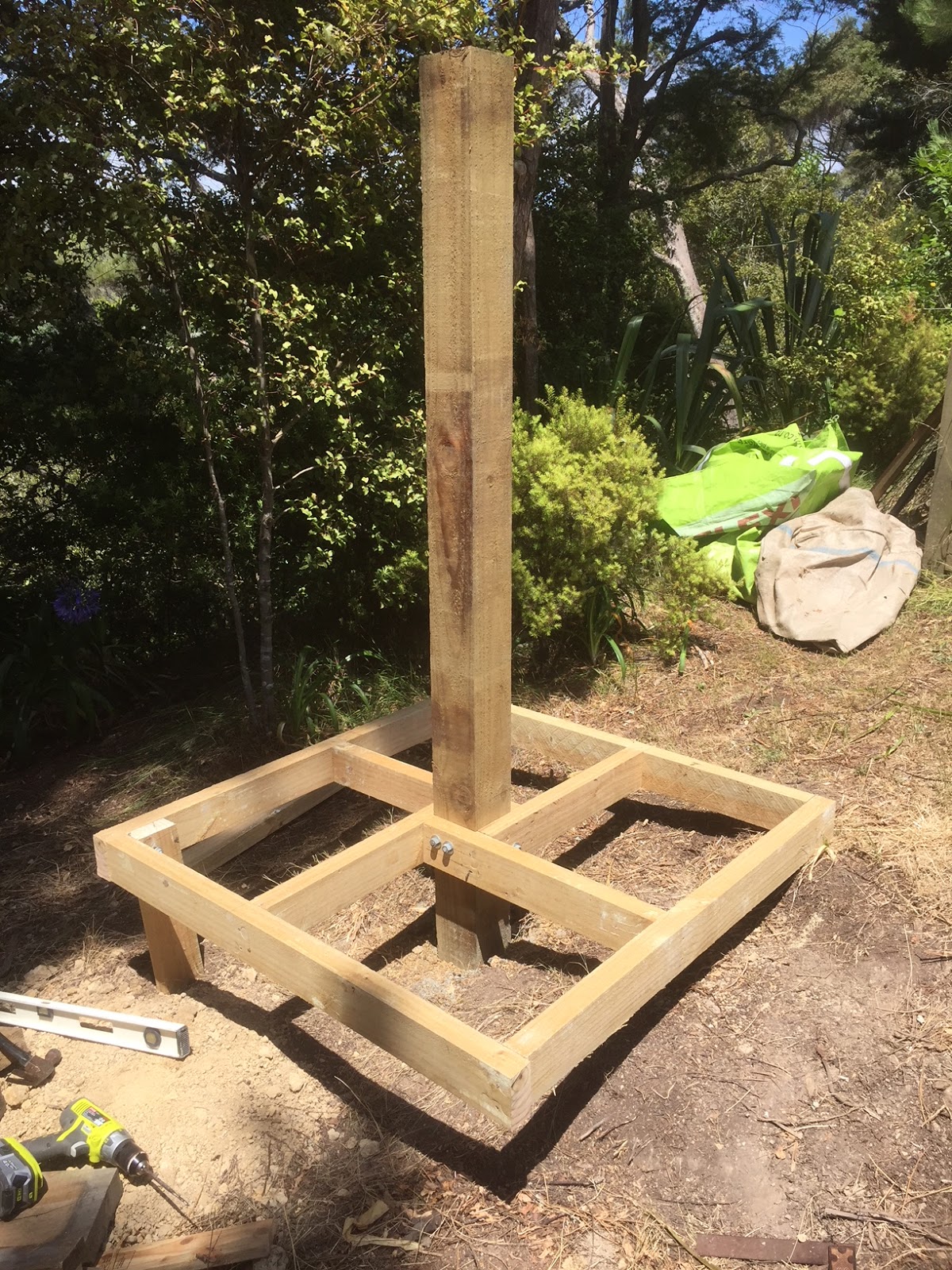
I decided to start with a single tanalised post in the ground and then built a frame for the floor out of 100x50mm rough sawn timber and bolted it to the post. Then I attached a sheet of plywood. When I tried standing on it, it wasn’t taking my weight as it was pivoting on the bolts, so I attached some legs to help support it.

I built each of the 4 sides on a flat surface from a plan I’d drawn, using 50x50mm battens in the corners to enable screwing the four sides together. I used the same battens to attach a couple of plywood shelves which finally resulted in a multi-level dwelling for them. I attached a few perches fanned out in a circle around the post so that they could easily make their way up and down as well as a simple ladder. I added a few little hinged doors in positions where I hoped the chooks would lay their eggs.

In one side of the coop I put a large door, hinged at the bottom to enable easy access for cleaning. The roof is also hinged at the apex on one side and is a handy way of taking a quick look inside. All that was needed then was some dried out grass clippings for them to make a nest out of and to make it more comfortable and homely.

When we first got the chooks they were still quite small and we were a bit worried about letting them roam freely in the yard until they got a bit bigger in case a cat decided to have one for dinner. So we started them off in an old ginea pig run. Then we made a little connecting tunnel with some plastic mesh to join the two together.


It was an exciting moment when we finally introduced the chooks to their new home. Amazingly, they made their way straight to the top floor to check out the view, which also brought them up to eye level for a face to face meeting.

They were still quite young at this point so it would be a while before any eggs would be laid.


Wednesday, July 24, 2013

The Mandarin Tree

Every year we look forward to the beautiful sweet, seedless fruit borne on the Mandarin tree just outside our kitchen window. However this year the fruit on the tree has taken a back seat to the avian visitors who’ve frequented it. They’ve made interesting subject matter for my rekindled interest in photography.

The tree attracts several different kinds of birds who seek out the bright orange, sweet fruit that this tree produces this time of year. As mentioned in my previous post about a Tui that’s been visiting the tree, moments later a rosella joined in, so I got a shot of him too...


Actually, Rosella’s usually travel in pairs and if you look carefully you’ll see there’s more than one rosella in the shot. Can you see the second one? All you can see is a flash of red to the left of the frame.  Seeing how well hidden it is might help you appreciate how tricky it was getting a clear shot of one of these birds. They’re pretty shy and they take off the moment they even spot any human.

They make a ‘cackling’ noise as they communicate with each other through the tree. Although they’re an introduced bird from Australia and considered a pest and a threat to other native species, I actually quite like them – they’re so colourful. A friend of mine actually caught one and tamed it and had it flying around inside his house. Probably not such a good idea when you think about all the droppings it left everywhere.

Another frequent visitor to the mandarin tree has been the ‘silver eye’ or the ‘wax eye’ as some like to call them. When you see them it becomes pretty clear why they’re named that. They have a distinctive white ring around their eyes. These birds dart in and out, moving around so quickly making them a challenge to shoot. So I was quite pleased to get this shot...


Having said all of the above, you can imagine what a treat it was one morning for my wife and I to witness all 3 birds in the tree at the same time. It was interesting to witness them interacting with each other. I’ve often wondered what is meant when I hear it said that “the Rosella is a threat to our native species”. Are the native birds physically threatened? Or is it the food supply or something else in their environment that is threatened?


Anyway, this was the first time I’d ever observed these 2 birds up so close to each other and while they kept their distance from each other and appeared weary of each other while they followed each other around the tree, there was no real confrontation between them. Moments after these shots were taken a third bird entered the scene...


This rather inquisitive Silver Eye also seemed weary of the rosella and was keeping his distance but he wasn’t afraid to get close enough for a good look at what he was up to. If he had to get away I bet he could easily out manoeuvre the Rosella.

So although we missed out on quite a bit of fruit off the tree this year, this was more than made up for being able to witness, photograph and share all this bird activity.


Monday, June 24, 2013

A Tui Visits the Garden

We have a mandarin tree right outside our kitchen window which bears beautiful, sweet, seedless fruit this time of the year.

The tree often plays host to various birds coming to get their fill of fruit. I’ve been yearning to catch this scene on a decent camera ever since I started this blog a few years ago and I’m happy to say I finally got around to getting myself a decent digital SLR. Although I’m still figuring out how to use it properly, the first few snaps I’ve taken on it are already a vast improvement over what I’ve managed previously when it comes to bird photography. So I hope to feature more birds in the future.

Within the space of 10 or 15 minutes I managed to get a shot of 2 of my favourite birds in the garden...

Firstly a native Tui...


This guy seems to be pretty fat and well fed, which explains all the holes in the fruit when we go to pick them for ourselves. But that’s a small price to pay in my opinion because I just love these birds. They produce the widest repertoire of sounds which are very distinctive and unique to the NZ Tui. 


Before you start questioning this bird’s fashion sense with his coloured bangles, I did a little research and discovered that these bands he’s wearing are part of a conservation effort to track and record the movements, diet and habitat of these birds throughout NZ. 

NZ residents who have an interest in the welfare of the native Tui are being encouraged to assist by notifying the organisers of this project of any bird sightings, providing their location and other details. The way I understand it, each individual bird can be identified by the unique combination of coloured bands on its legs. For more info visit the website here

Tuis often feed on flowering plants and trees and it wasn’t until I started looking closely at these photos that I noticed they have a rather long tongue, which I’m guessing they use to extract the nectar from flowers.


The Tui is very much treasured in NZ but they have come under threat at various times from other bird species who they seem to compete with for food and territory. One such competitor is the second of these birds that visited the same tree moments later — an introduced Australian Rosella. I’ll do a separate post about this later – stay tuned.

Wednesday, September 5, 2012

Spring Has Sprung

Spring arrived early this year. 


These photos were taken August 24th. The plum blossoms usually signal the beginning of spring which arrived about a week earlier than normal. It was especially heartening to see the plum tree blossoms being visited by all sorts of insects including bees, bumblebees and butterflies. 

Last year most of the blossoms got turned to mush when a heavy downpour of rain came before they’d been pollenated, which resulted in a very small crop. This year I reckon every single flower got pollenated as the weather and insect visitation was almost perfect for an entire week.

I was so delighted at this first sign of spring I felt a video would be the best way to capture it, as the still photos just didn’t do it justice. They couldn’t possibly capture the sound of bees buzzing or the birds chirping in the surrounding trees. 

I found this video is best enjoyed at night with the volume turned up.

Enjoy...


Wednesday, June 15, 2011

A Wood Pigeon comes for a visit


One of the more privileged sights for bird watchers in New Zealand is that of the Native NZ Wood Pigeon. (Also known as Kereru which is the Maori name) The Wood pigeon would have to be the biggest bird to ever visit my garden. According to Wikipedia, they can grow to be 55cm long (20 inches) from head to tail weighing up to 850grams (1.87 pounds). When you witness one up close they seem much bigger. They're often seen gorging themselves on tree borne berries. This shot was taken in a tree privot outside our kitchen window. (In NZ Privot is classified as a noxious weed and at this time of year they're covered in berries.)


The first time I witnessed a wood pigeon landing in Loquat tree (which is one of their favourites), I swore the branch was nearly going to snap under its weight. They can be quite comical to watch after they get a belly full of berries. Not only are they weighed down all the more from pigging-out on all the fruit but as the fruit ferments in their gut they become intoxicated and have difficulty getting air borne again.


But when they do it's a spectacular sight. If you're ever standing nearby, the "Wooshing" sound they make when they take to flight is quite breathtaking. You can't help but marvel at these beautiful creatures. And then he was gone...

This photo taken by Michelle from Christchurch 
shows off the beauty of this birds' paua shell colouring...


I really must get myself a decent camera!

Sunday, May 15, 2011

Tiger Finches in the Garden

One thing I really love about my garden is all the birds that come visiting. Unfortunately I've never got my camera handy at the opportune moment when I suddenly find myself up close and personal with some of these birds. I've only got an average camera so I can't zoom in very well or catch anything that's moving too fast, but I am quite pleased with this shot that I managed to get of a Tiger Finch in mid flight...


It's only at certain times of the year when the Tiger Finches come around. They seem to travel in pairs and I managed to get a shot of them together (below), apparently feeding on the seeds of these flowers. The most common place to view Tiger Finches in New Zealand is in a cage at the local pet shop, so it was quite a privilege to see them in their natural environment and to get a shot of them.